
Standing With Survivors,
Ending SGBV


BLOG & INSIGHTS

Welcome to the AASEV Blog—where depth meets action. This is our space for analysis, reflection, and storytelling beyond the headlines. Here, we explore the why behind the what, share survivor-informed perspectives, and dive into the ideas shaping our fight to end sexual violence in Zambia.
Read, reflect, and join the conversation.
Featured Post
Beyond the Courtroom: Why Healing and Justice Must Walk Together
By The Survivor Support & Outreach Department | Date
A court gavel strikes. A verdict is read. For a survivor of sexual violence, this moment can bring a surge of relief—a long-awaited acknowledgment of harm. But what comes next?
The truth is, a survivor’s journey doesn’t end with a verdict.
At AASEV, we witness this reality daily. A legal win can feel hollow if the survivor returns home to isolation, financial ruin, and unprocessed trauma. Conversely, therapeutic healing can feel fragile and incomplete if the survivor lives with the daily fear that their perpetrator faces no consequence. This is why we believe healing and justice are not sequential steps, but parallel paths that must be walked together.
The Hollow Victory: Justice Without Healing
The Zambian justice system, even when it works, is often an adversarial arena. Survivors are cross-examined, evidence is scrutinized, and their most traumatic experience becomes a public case file. Securing a conviction is a monumental fight, but emerging from that fight can leave a person emotionally shattered.
Without dedicated psychosocial support—counselling, safety planning, and community reintegration—a legal victory can become a pyrrhic one. The survivor may have "won" in court, but they can be left alone to manage the aftershocks: flashbacks, stigma, economic vulnerability, and a broken sense of trust. Justice, in this sense, addresses the crime against the state, but not the profound human injury.
The Fragile Foundation: Healing Without Justice
On the other hand, supporting a survivor’s mental and emotional recovery while the perpetrator walks free is like building a house on quicksand. The lack of legal accountability perpetuates a profound injustice that undermines healing. It sends a message that the harm done to them does not matter to society, reinforcing feelings of worthlessness and powerlessness.
The fear of encountering the perpetrator, the anger at a system that appears indifferent, and the silence imposed by community pressure can all re-traumatize a survivor, undoing the hard work of therapeutic progress. Healing requires safety, and true safety is impossible in the shadow of impunity.
The AASEV Model: Integrated Pathways
This is the core rationale behind AASEV’s integrated four-pillar model. We reject the false choice between legal aid and counselling. Our departments are designed to work in sync, ensuring that as our Justice & Legal Advocacy Department fights in the police station and the courtroom, our Survivor Support & Outreach Department is providing a safe haven, trauma counselling, and economic empowerment.
This is what walking together looks like:
-
A survivor is accompanied to court by a legal officer, but also debriefs after the hearing with a counsellor.
-
The Empowerment Fund helps a survivor start a business, restoring independence lost when the breadwinner-perpetrator is arrested—a direct intervention that supports both their economic healing and their ability to stay the course in a lengthy trial.
-
Insights from support groups about the pressures survivors face directly inform the policy reforms championed by our Reform Advocacy Department.
True Recovery is Holistic
True recovery is not a single outcome. It is a state where a survivor can feel both externally vindicated by the law and internally restored in their dignity and strength. It is when the closure of a case file coincides with the opening of a new chapter in their life.
We must stop asking survivors to choose between justice and healing. The demand for accountability and the need for compassion are two sides of the same coin. At AASEV, we are committed to ensuring that every survivor we walk with receives both, because a Zambia free from sexual violence must be a nation that delivers both.
Because healing is the destination, but justice is the path that makes the journey possible.
Recent Articles
The Data Doesn’t Lie: Breaking Down Zambia’s SGBV Crisis in 5 Charts
The Data Doesn’t Lie: Breaking Down Zambia’s SGBV Crisis in 5 Charts
By Reform Advocacy Department | Date
What do the numbers really tell us? We visualize the latest data on reporting rates, prosecution gaps, and regional disparities to highlight where systemic change is most urgent.
By The Reform Advocacy Department | December 2024
In the fight against sexual and gender-based violence (SGBV), emotion compels action, but evidence dictates strategy. Behind the headlines and heartbreaking stories lies a landscape defined by numbers—numbers that reveal systemic failures, urgent gaps, and clear pathways for intervention.
At AASEV, our advocacy is driven by data. We believe you cannot fix what you do not measure. So, what do the numbers really tell us about Zambia’s SGBV crisis? We’ve visualized the latest available data to move beyond awareness and into actionable understanding.
Here is Zambia’s SGBV crisis, broken down in 5 critical charts.
Chart 1: The Alarming Trajectory – Reported Cases (2016–2024)

This is the trend that sparked a national movement. A 190% increase in reported sexual violence cases since 2016 is not a statistical anomaly; it is the signature of a deepening crisis. While increased reporting can reflect growing awareness and slightly more trust in systems, this exponential rise overwhelmingly signals a surge in violence against women and girls. It represents 2,646 individual tragedies in 2024 alone—and these are only the cases brave enough to be formally reported.
What it means: We are not facing a fleeting problem, but a worsening epidemic. Demand for services is skyrocketing, and our national response must scale with equivalent urgency.
Chart 2: The Justice Gap – From Report to Conviction

This funnel illustrates the devastating attrition of justice. For every 100 cases reported:
-
Only 37 make it to prosecution.
-
A mere 12 result in conviction.
A conviction rate of 12.4% is more than a statistic; it is an engine of impunity. It tells perpetrators they are statistically likely to walk free, and it tells survivors that the system is stacked against them. This gap—between the crime and the consequence—is where fear, coercion, and systemic failure thrive.
What it means: Improving reporting is only half the battle. We must urgently repair the broken pipeline of investigation, prosecution, and adjudication. This is why our advocacy demands Fast-Track Courts and strengthened legal procedures
Chart 3: The Burden of Silence – Estimated Reporting Gap

The official figures are just the tip of the iceberg. Global and local studies consistently suggest that for every case of sexual violence reported, many more—often 9 times as many—go unreported due to stigma, fear, economic dependence, distrust in authorities, or threats.
This hidden crisis means the true scale of suffering is vastly greater than the records show. It underscores that our support systems must be accessible, trustworthy, and safe enough to reach into the silence.
What it means: Our work in community awareness and safe outreach is not supplementary; it is fundamental to bridging this gap and bringing hidden survivors out of the shadows.
Chart 4: The Geographic Disparity – Case Reports by Province (2024)

[Visual: A map or bar chart of Zambia’s provinces, with Lusaka, Copperbelt, and Central Provinces showing significantly higher reported cases than Northern, Muchinga, and Western Provinces.]
Violence is everywhere, but reporting is not. Higher reported cases in urban and peri-urban provinces like Lusaka and the Copperbelt likely reflect better access to police, hospitals, and NGOs. Lower numbers in more rural provinces do not mean less violence; they signal greater isolation, fewer services, and larger barriers to reporting.
This disparity highlights a dangerous inequality in protection and justice across our own nation.
What it means: A national strategy cannot be Lusaka-centric. We must decentralize support services, invest in rural awareness campaigns, and empower traditional structures to become referral points, not roadblocks.
Chart 5: The Survivor Profile – Age & Gender of Reported Victims (2024)

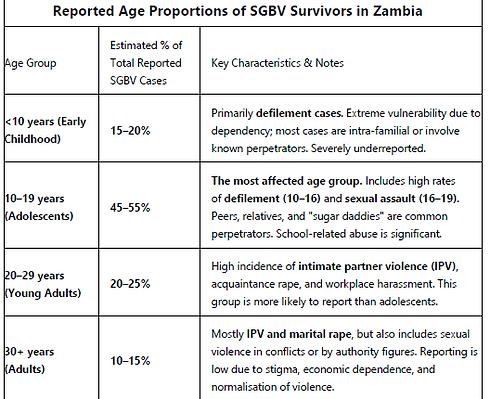
*[Visual: A bar chart showing the overwhelming majority of reported victims are female (approx. 95%+). A stacked bar or secondary chart shows a devastating concentration of cases among children and adolescents, with the highest bar in the 10-17 age bracket.]*
The data confirms what we know anecdotally: this crisis has a specific face. Women and girls bear the overwhelming burden, and children are disproportionately targeted. The high incidence in the 10-17 age range is a national emergency within an emergency, pointing to urgent failures in child protection at every level—home, school, and community.
What it means: Our prevention and response must be age- and gender-sensitive. This demands targeted school programs, specialized pediatric medical and psycho-social services, and laws that specifically protect children, such as stricter concealment laws and harsher minimum sentences for defilement.
Conclusion: From Data to Demand
These charts are not just illustrations; they are indictments and blueprints. They indict a system that fails to protect, prosecute, and prevent. They provide a blueprint for where we must focus our national effort: closing the justice gap, reaching unreported survivors, bridging geographic disparities, and protecting our children.
At AASEV, this data fuels our Reform Advocacy Agenda. Every demand we make—for fast-track courts, a Sexual Offenders Registry, harsher sentences, and rural safe houses—is a direct response to what these numbers reveal.
The data doesn’t lie. And neither will we. The fight continues.
Featured Post
Mobilizing Men: Inside Our Positive Masculinity Workshops
By ................. Awareness & Prevention Department | Date
Prevention requires everyone. A firsthand account from a facilitator on engaging men and boys as allies, breaking down harmful norms, and fostering a culture of respect from the ground up.[Read More →]
A Day in the Life of a Legal Advocate
By .........Justice & Legal Advocacy Department | Date
From police stations to courtrooms—follow a typical day for an AASEV legal volunteer navigating the justice system alongside survivors.[Read More →]
The Power of Community: How Youth Watch Committees Are Changing Narratives
Community Correspondent | Date
Spotlight on the young volunteers in ............................... compounds who are becoming frontline defenders and educators in their own neighborhoods.
[Read More →]
In-Depth Series
"The Reform Agenda"
A monthly series breaking down our key policy demands—from fast-track courts to the Sexual Offenders Registry—explaining the what, the why, and the how of systemic change.
[Start with Part 1: The Case for Fast-Track Courts →]
Welcome to the AASEV Blog—where depth meets action. This is our space for analysis, reflection, and storytelling beyond the headlines. Here, we explore the why behind the what, share survivor-informed perspectives, and dive into the ideas shaping our fight to end sexual violence in Zambia.
Read, reflect, and join the conversation.
Guest Contributors
A Prosecutor’s Perspective: The Challenges in Securing SGBV Convictions
By Guest Contributor, Senior State Advocate | October 28, 2024An insider’s view on the procedural gaps, evidence challenges, and institutional pressures that complicate the prosecution of sexual offence cases in Zambia.[Read More →]
Interested in contributing as a guest writer?
Submit your pitch: aasevzambia@gmail.com
Subject: Blog Insights
Subscribe for Thought Leadership
Don’t miss a post. Get our latest analysis, stories, and insights delivered directly to your inbox.
[Enter your email address]
[Subscribe to the Blog]
We respect your privacy. Unsubscribe at any time.
Join The Conversation
We believe in the power of dialogue. Have a thought or question about a post? Share it respectfully in the comments section on each article (coming soon) or tag us on social media using #AASEVInsights.
Follow the discussion on:
This blog is more than articles—it’s a growing archive of our collective learning, courage, and unwavering commitment to a safer Zambia. Thank you for reading, thinking, and acting with us


